Choosing the right Linear Cross Roller Bearing begins with understanding the machine, not the catalog page. A compact actuator, inspection stage, or semiconductor platform may demand very different performance. Each application exposes the bearing to a specific load pattern, speed range, stroke length, and contamination risk.
Dr. Tedric A. Harris, a respected rolling-bearing analyst, stated, “Bearing life depends on load, speed, lubrication, and contamination.” That principle remains practical today. A bearing can look perfectly sized on paper and still fail early when dust enters the raceway. I have seen this mistake in compact equipment: engineers checked radial capacity but overlooked moment load from an offset table. The result was uneven motion and premature wear.
This guide, “7 Tips for Choosing a Linear Cross Roller Bearing,” examines the details that are easy to miss. We will consider load direction, stiffness, accuracy, preload, travel conditions, lubrication, and installation quality. Small differences matter. A few microns can affect positioning. Excessive preload can increase friction and heat. Insufficient preload can create vibration and lost accuracy.
Do not choose by size alone. That shortcut is tempting. It is also unreliable. The best selection balances rigidity, smooth movement, service life, environmental conditions, and maintenance access. Even experienced designers should recheck assumptions with real operating data. A laboratory test may not represent production dust, changing temperatures, or imperfect mounting surfaces. Careful selection is less dramatic, but it prevents expensive surprises.
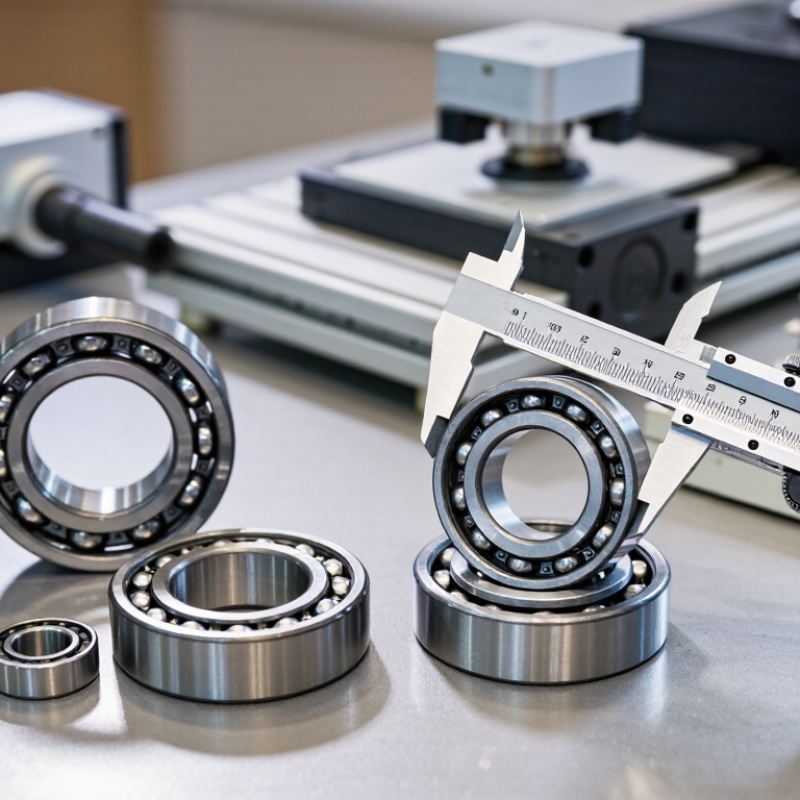
7 Tips for Choosing a Linear Cross Roller Bearing
A linear cross roller bearing uses cylindrical rollers arranged alternately at 90 degrees. Each roller supports load on a narrow, controlled contact line. This structure handles radial, axial, and moment loads in one compact guide. Check the roller arrangement, raceway hardness, cage design, and preload. These details affect stiffness, friction, and service life.
Motion accuracy requires more than a small clearance value. ISO 230-2 evaluates positioning accuracy, repeatability, and reversal error in machine axes. During selection, request measured running parallelism and radial runout data. A guide that feels smooth by hand may still create several micrometres of error under load. It happens. Temperature, mounting flatness, and contamination can change the result.
ISO 14728-1:2012 defines basic dynamic load rating C and basic static load rating C0 for linear rolling bearings. For roller bearings, the nominal life relationship uses L10 = (C/P)10/3, expressed in millions of metres under specified conditions. P is the equivalent load, not simply the largest applied force. Include moment load and acceleration when calculating it. A higher C rating is not automatically better if preload increases friction. That assumption deserves review. Use test data, installation tolerances, and real duty cycles before approving the final bearing.
| Tip | Selection Dimension | What to Check | Practical Guidance |
|---|---|---|---|
| 1 | Cross-roller structure | Roller orientation, raceway geometry, cage design, and guide configuration | In a cross-roller arrangement, cylindrical rollers are positioned alternately at approximately 90° to one another between matching raceways. Confirm that the rail, carriage, and mounting arrangement suit the required load directions. |
| 2 | Travel and stroke | Required working travel, end clearance, and cage movement | Many cross-roller guides use a cage and have finite travel. Check the usable stroke and the maker’s guidance on cage displacement, end stops, and operation near the travel limits. |
| 3 | Load and moment capacity | Forces in each direction, overturning moments, load position, and duty cycle | Calculate the applied forces and moments for the actual carriage layout. Consider acceleration, impact, and load eccentricity; a load rating alone does not describe every combined-load condition. |
| 4 | Motion accuracy | Running parallelism, straightness, repeatability, and angular error | Specify accuracy using measurable limits that match the application. Check the reference length, measurement method, mounting surface, and whether the stated value applies to the rail, carriage, or assembled guide. |
| 5 | ISO dynamic rating and life | Basic dynamic load rating, commonly designated C, and the stated rating-life method | ISO 14728-1 covers dynamic load ratings and rating life for linear motion rolling bearings. Compare ratings only when the units, bearing type, operating assumptions, and calculation method are consistent; C is not a recommended continuous working load. |
| 6 | Static load and preload | Static load rating, risk of permanent deformation, preload, and starting resistance | Check static capacity separately for stationary or shock-loaded conditions. ISO 14728-2 addresses static load ratings. Preload can improve rigidity, but excessive preload may increase friction and heat. |
| 7 | Installation and operating environment | Mounting-face flatness, fastening sequence, lubrication, contamination, and temperature | Use the specified mounting tolerances and tightening procedure. Keep raceways clean, select compatible lubrication, and account for dust, coolant, corrosion, and temperature effects on accuracy and service life. |
Selection note: ISO 14728-1 provides a framework for dynamic load ratings and rating life; it does not define a universal motion-accuracy grade for every linear cross-roller bearing. Confirm product-specific accuracy, static capacity, permissible moments, and life assumptions in the applicable technical documentation.
It uses cylindrical rollers arranged at alternating right angles. The rollers support loads along narrow contact lines.
It can support radial, axial, and moment loads in a compact guide. Combined loads still need careful calculation.
Review measured running parallelism and radial runout. Also check positioning repeatability under the actual operating load.
Equivalent load, speed, preload, alignment, and lubrication all matter. The largest force alone may not describe the real load.
Match roller size to load and available space. Include overtravel, mounting tolerances, and room for seals or covers.
Excessive clearance can cause play, while high preload can increase friction and heat. Test the fit in the assembled machine.
Check combined loads and mounting errors. Measure movement with a dial indicator or displacement sensor.
Test the real stroke, acceleration, and cycle frequency. Use compatible lubricant, then check running force and temperature.
Inspect the raceway after a short trial. Darkened grease, rising noise, or uneven movement deserve attention.
No. A guide can feel smooth without meeting accuracy requirements under load. It happens.
Choosing the right Linear Cross Roller Bearing requires a clear understanding of its crossed-roller structure, which supports smooth linear motion with high accuracy and rigidity. Begin by defining the required motion performance and reviewing ISO 14728-1 ratings to ensure the bearing meets applicable dimensional and load expectations. Match the dynamic load capacity and calculated L10 life to the application’s duty cycle, considering operating loads, frequency, and expected service duration.
Next, select an appropriate roller size and stroke length while allowing for the clearance needed to achieve the required precision. Preload and accuracy class should be carefully specified to balance rigidity, friction, and positioning stability. Finally, verify the bearing’s allowable speed, lubrication method, sealing requirements, and compatibility with temperature, dust, moisture, or other environmental conditions. A complete evaluation of these factors helps ensure reliable operation, consistent accuracy, and long-term performance.

 Manchen Transmission