How to Choose a Double Row Spherical Roller Bearing?

Time:2026-10-27 Author:Mason
0%

Choosing a Double Row Spherical Roller Bearing requires more than comparing load ratings. Field experience shows that incorrect alignment, poor lubrication, and contaminated housings often cause premature failure. The bearing may look oversized, yet still fail under vibration or uneven loading.

ISO 281:2007 provides the standard method for calculating bearing fatigue life. It considers dynamic load ratings, equivalent loads, and operating conditions. ISO 15243:2017 also helps engineers classify damage, including wear, smearing, corrosion, and surface fatigue. These standards support a disciplined selection process. However, calculations cannot replace practical inspection.

Real conditions matter.

The SKF General Catalogue emphasizes load capacity, permissible speed, internal clearance, sealing, and lubrication when selecting spherical roller bearings. Timken’s Engineering Manual similarly connects bearing life with mounting accuracy, shaft fits, housing support, and operating temperature. SKF’s Annual Report 2023 also highlights the importance of reliability, maintenance, and efficiency across industrial equipment applications.

A suitable Double Row Spherical Roller Bearing must match radial load, limited axial load, misalignment, shaft diameter, and rotation speed. A paper mill roll may need strong sealing against water and fiber particles. A vibrating screen may require high clearance and improved cage strength. A gearbox may demand tighter control of heat and lubrication.

There is no perfect selection.

Engineers should verify catalogue data against actual loads, shock levels, temperature, and maintenance access. Small assumptions can create large failures. This guide explains how to compare bearing specifications, interpret manufacturer data, and avoid common selection mistakes with greater confidence.
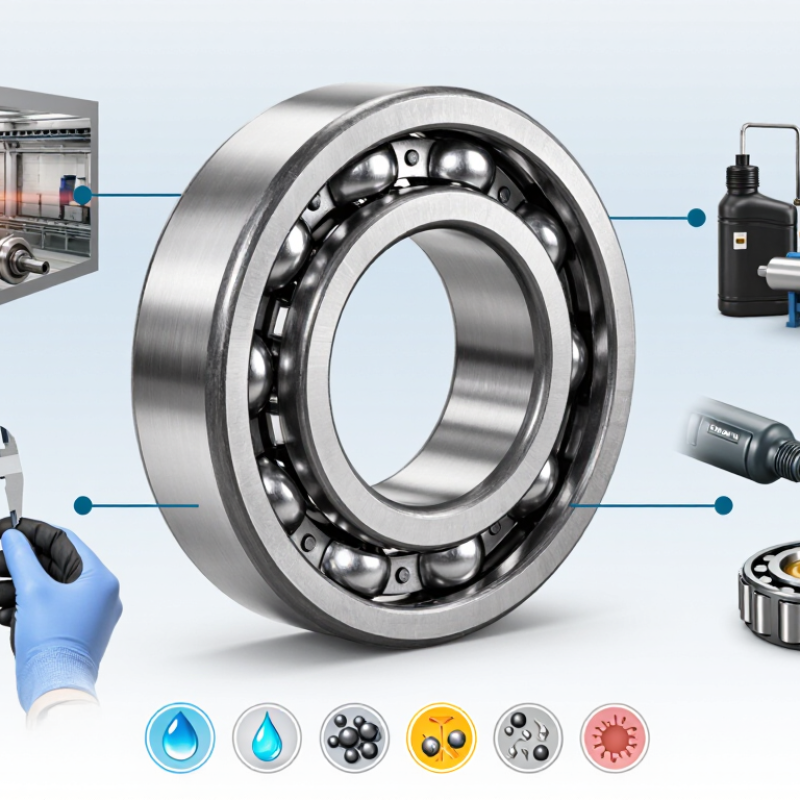
How to Choose a Double Row Spherical Roller Bearing?

Understand the Structure and Working Principles of Spherical Roller Bearings

How to Choose a Double Row Spherical Roller Bearing?

A double row spherical roller bearing contains two rows of barrel-shaped rollers. These rollers run between an inner ring and a spherical outer raceway. A cage keeps the rollers spaced during rotation. This arrangement supports heavy radial loads and limited axial loads from both directions. Its spherical outer raceway allows the bearing to tolerate shaft deflection and housing misalignment. That feature is useful in conveyors, gearboxes, crushers, and other demanding equipment.

The working principle is simple but easy to underestimate. As the shaft turns, the rollers distribute load across several contact zones. Misalignment changes the roller position, while the curved raceway keeps contact reasonably stable.

Correct internal clearance is essential. Too little clearance may increase heat and reduce service life. Too much can create vibration and uneven loading. Selection should consider load, speed, shaft size, housing accuracy, lubrication, and expected deflection. In practice, calculations are not always neat. Real vibration and temperature data may change the final choice.

Tips: Check the required radial and axial load separately. Confirm the permissible misalignment in the technical data. Use suitable grease or oil for the operating speed and temperature. During installation, apply force only to the ring being fitted. A small mounting error can damage the raceways before operation begins. Recheck clearance after installation, because this step is often overlooked.

Identify Load Types, Speeds, and Operating Conditions

Choosing a double row spherical roller bearing starts with identifying the actual load pattern.

Heavy radial loads suit this design well. Axial loads may act in both directions, but their size must be checked carefully. Shock loads also matter.

A conveyor drum, vibrating screen, and gearbox can require different internal clearances and load ratings.

Speed changes the decision.

Compare the operating speed with the bearing’s reference and limiting speeds. Do not rely on speed alone.

Lubricant viscosity
Cage design
Heat dissipation
Mounting accuracy

Lubricant viscosity, cage design, heat dissipation, and mounting accuracy can reduce safe performance. A bearing running near its limit may feel acceptable during a short test, then overheat after several hours. That detail is easy to miss.

Operating conditions deserve equal attention.

Dust, water, high temperatures, and frequent starts can shorten service life. Choose suitable seals, grease, or oil circulation for the environment.

Check shaft fits, housing stiffness, misalignment, and clearance before installation.

Excessive interference can remove needed clearance and raise operating temperature. Insufficient interference can allow ring creep.

In field maintenance, incorrect lubrication is often blamed on the bearing, although the grease amount or relubrication interval was wrong.

Calculate the required dynamic load rating and estimated L10 life, then compare the result with real duty cycles. Catalog data helps, but site measurements should challenge assumptions.

Select the Correct Bearing Size, Clearance, and Load Capacity

How to Choose a Double Row Spherical Roller Bearing?

Select the Correct Bearing Size, Clearance, and Load Capacity

Start with the shaft diameter, housing space, and operating speed. Measure both parts carefully, because drawings can hide wear or small misalignments. Then compare the bearing’s dynamic rating with the real radial load. Use the equivalent dynamic load to estimate L10 life. A larger bearing is not always better. It may increase friction, weight, and installation difficulty. Field measurements can disagree with old records.

Clearance deserves equal attention. An interference fit can reduce internal clearance after mounting. Operating heat may reduce it further as the shaft expands. Choose clearance according to fit, temperature, speed, and shaft material. Excessive clearance can cause vibration and uneven roller contact. Insufficient clearance can create heat, noise, and early damage. Check the temperature after running. Do not trust selection tables blindly.

Load capacity must include radial, axial, shock, and reversing loads. For combined loading, calculate the equivalent bearing load instead of using radial load alone. Include peak loads from starts, stops, and sudden machine changes. Check the static safety factor when heavy impact is possible. A catalog match is not proof. I have seen correct dimensions fail under unexpected vibration. Review lubrication, mounting accuracy, and housing stiffness as well. Small installation errors matter. Recheck the selection after a short trial run.

How to Choose a Double Row Spherical Roller Bearing? - Select the Correct Bearing Size, Clearance, and Load Capacity

Selection Dimension What to Check Selection Guidance Practical Notes
Bore Diameter (d) Shaft diameter, shaft tolerance, and mounting method Select the bearing bore to match the shaft. Use an adapter sleeve or withdrawal sleeve when a tapered or sleeve-mounted arrangement is required. The shaft fit must prevent creep while allowing correct radial internal clearance after mounting.
Outside Diameter (D) Housing bore, wall thickness, and available radial space Choose the smallest outside diameter that satisfies the required load rating and service life while maintaining adequate housing strength. Check housing distortion, mounting shoulders, seals, and adjacent components.
Bearing Width (B) Axial installation space and shoulder dimensions Confirm the available width, locating-ring arrangement, and the required axial positioning of the shaft. Do not clamp the bearing rings axially unless the design specifically requires it.
Radial Load (Fr) Constant and variable radial forces Use the maximum or equivalent radial load, including belt, gear, rotor, gravity, and shock loads. For variable loads, calculate an equivalent load using the applicable load spectrum.
Axial Load (Fa) Magnitude, direction, and duration of thrust load Use the bearing-specific equivalent dynamic load equation and coefficients supplied for the selected bearing geometry. A spherical roller bearing can carry combined radial and axial loads, but the allowable axial load depends on speed, lubrication, clearance, and design.
Dynamic Load Rating (C) Required rating life and equivalent dynamic bearing load (P) For roller bearings, use L10 = (C/P)10/3, where L10 is in millions of revolutions. C and P must use consistent units, such as newtons or kilonewtons.
Static Load Rating (C0) Stationary load, shock load, low-speed operation, and indentation risk Check the static safety factor using s0 = C0/P0, where P0 is the equivalent static load. The required safety factor depends on shock, vibration, noise, and smooth-running requirements.
Radial Internal Clearance Operating temperature, interference fits, shaft or housing distortion, and speed Normal clearance is suitable for many standard applications. Increased clearance grades such as C3 or C4 may be required for heavy interference fits or elevated operating temperatures. Clearance values vary with bearing size and series. Always use the dimensional limits in the selected bearing catalogue.
Operating Temperature Steady temperature, transient peaks, and temperature difference between inner and outer rings Select suitable material, heat treatment, lubricant, seal arrangement, and internal clearance. Thermal expansion can reduce operating clearance and cause overheating or premature failure.
Rotational Speed Required rpm, acceleration, cage design, and lubrication method Compare the application speed with the catalogue reference speed and limiting speed for the specific design. Speed limits depend on load, lubricant, cooling, clearance, cage type, and operating temperature.
Misalignment Housing deflection, shaft bending, and alignment error A spherical roller bearing is designed to accommodate angular misalignment, subject to the permissible value for the selected design. Misalignment increases friction and heat; accurate housing alignment is still recommended.
Lubrication Grease or oil, viscosity, relubrication interval, contamination, and speed Select lubricant viscosity and quantity according to load, speed, temperature, and environmental conditions. Inadequate lubrication is a common cause of overheating, wear, and surface fatigue.

Common Dimensional Examples

Generic Bearing Size Bore d (mm) Outside Diameter D (mm) Width B (mm) Typical Application Consideration
22208 40 80 23 Compact equipment with moderate radial loads
22210 50 90 23 General industrial machinery and conveyor components
22212 60 110 28 Higher load capacity where moderate radial space is available
22216 80 140 33 Heavy-duty drives, gear units, and material-handling equipment
22220 100 180 46 Large radial loads and applications requiring high rigidity
22224 120 215 58 High-load machinery with substantial shaft and housing capacity

Internal Clearance Selection

Clearance Class General Meaning Suitable Conditions Caution
CN / Normal Standard radial internal clearance Typical loads, moderate temperatures, and standard mounting fits Verify that fit-related clearance reduction does not leave insufficient operating clearance.
C2 Smaller-than-normal radial clearance Special applications where low operating clearance is required and thermal expansion is limited Not normally selected for heavy interference fits or high operating temperatures.
C3 Larger-than-normal radial clearance Higher temperatures, heavier interference fits, shaft bending, or housing distortion Excessive clearance can increase vibration, noise, and roller load variation.
C4 / C5 Substantially larger radial clearance grades Special thermal, mounting, or operating conditions determined by engineering calculation Use only when supported by the application calculation and the selected bearing manufacturer’s limits.
Example sizing calculation: For a roller bearing operating at 600 rpm for 20,000 hours with an equivalent dynamic load of 15 kN:
Required life = 600 × 60 × 20,000 / 1,000,000 = 720 million revolutions.
Required basic dynamic load rating: C = P × L103/10 = 15 × 7203/10 ≈ 108 kN.
Select a bearing with a catalogue dynamic load rating above this value, then verify static safety, speed, clearance, lubrication, and mounting conditions.

Compare Sealing, Lubrication, and Material Requirements

How to Choose a Double Row Spherical Roller Bearing?

Sealing, lubrication, and material requirements should match the machine’s actual working conditions. During bearing inspections, dirt marks often reveal more than a catalog specification. A sealed bearing can block dust, water, and washdown spray. However, its seals may increase friction and operating temperature. Check the shaft speed, temperature range, and available space before choosing this design.

Open bearings suit heavy loads and regular relubrication. Select grease by load, speed, temperature, and moisture exposure. Avoid mixing greases unless their thickener and base oils are compatible. Oil lubrication may perform better at high speed or when heat must be removed continuously. Measure the heat. A simple temperature check can expose poor lubrication, misalignment, or an unsuitable seal.

Material selection also depends on the duty cycle. Through-hardened bearing steel is common for heavy radial and impact loads. Corrosion-resistant materials may help in humid environments, but they can require different load calculations. Cage material matters under vibration, shock, and high temperature. Confirm shaft hardness, housing fit, surface finish, and alignment limits together. A neat checklist can still mislead. Real machines rarely stay clean, dry, or perfectly aligned. Keep records from installation and early operation, then adjust the sealing or lubrication plan when evidence demands it.

Verify Installation, Maintenance, and Manufacturer Specifications

How to Choose a Double Row Spherical Roller Bearing?

A reliable choice begins with the installation environment, not just the bearing size. Confirm the shaft diameter, housing bore, shoulder dimensions, and required fit against the manufacturer’s drawings. Measure everything. Check for burrs, corrosion, and soft mounting surfaces before assembly. Keep it clean. Press force must act through the fitted ring, never through the rolling elements. Excessive heating can also damage internal clearance.

After installation, verify shaft rotation, axial movement, and alignment. A dial indicator can reveal unwanted runout before the machine reaches operating speed. During service, monitor temperature, vibration, noise, and grease condition. Record actual readings instead of relying on memory. Relubricate according to load, speed, contamination, and operating temperature. More grease is not always safer. Over-lubrication may increase heat and shorten bearing life.

Manufacturer specifications remain essential for final selection. Compare dynamic and static load ratings, limiting speed, internal clearance, allowable misalignment, and lubrication requirements. Confirm whether the bearing suits shock loads, changing directions, or continuous operation. Installation instructions may differ between similar-looking models. That detail is easy to overlook. A bearing can fit physically yet perform poorly under the real load. Review the operating data with a qualified engineer when conditions are uncertain. I would also revisit the choice after the first inspection cycle, because early wear can expose assumptions that looked reasonable on paper.

How to Choose a Double Row Spherical Roller Bearing?

Verify Installation, Maintenance, and Manufacturer Specifications

The chart shows realistic example readings used during bearing verification: shaft runout, radial internal clearance, vibration velocity, and temperature rise. These measurements should be checked after installation and during operation, then compared with the exact tolerances, clearance class, load ratings, speed limits, and lubrication requirements specified for the selected bearing.

Example readings only: shaft runout 18 μm, radial internal clearance 70 μm, vibration 2.8 mm/s RMS, and temperature rise 28°C. Acceptance limits are application- and manufacturer-specific.

FAQS

What is a double-row spherical roller bearing?

It contains two rows of barrel-shaped rollers between inner and spherical outer raceways. A cage keeps the rollers separated.

What loads can this bearing support?

It mainly supports heavy radial loads and limited axial loads from both directions. Check each load separately.

How does the spherical outer raceway help?

It tolerates shaft deflection and housing misalignment. This helps conveyors, gearboxes, crushers, and similar equipment operate more reliably.

Why is internal clearance important?

Too little clearance can raise heat and shorten service life. Too much may cause vibration and uneven roller loading.

What factors should guide bearing selection?

Consider load, speed, shaft diameter, housing accuracy, lubrication, expected deflection, and shock conditions. Real measurements may change the calculation.

What should be checked before installation?

Measure the shaft, housing bore, shoulders, and required fits. Remove burrs and corrosion. Keep the mounting surfaces clean.

How should installation force be applied?

Apply force only through the ring being fitted. Never press through the rollers, because raceways may be damaged before operation begins.

What should be monitored after installation?

Check rotation, axial movement, alignment, temperature, vibration, noise, and grease condition. A dial indicator can reveal unwanted runout.

Is adding more grease always better?

No. Over-lubrication can increase heat and shorten service life. Lubrication should match speed, load, contamination, and temperature.

When should the selection be reviewed again?

Review it after the first inspection cycle. Early wear may reveal assumptions that seemed reasonable on paper. Real machines can disagree.

Conclusion

Choosing the right Double Row Spherical Roller Bearing starts with understanding its structure and self-aligning working principle. Its two rows of rollers support heavy radial loads while accommodating shaft misalignment, making it suitable for demanding machinery. Begin by evaluating the load type, rotational speed, temperature, vibration, moisture, dust, and other operating conditions. These factors determine the required bearing size, internal clearance, load capacity, and dimensional design.

Next, compare sealing and lubrication options according to the working environment and maintenance schedule. Select suitable materials and protective features when the application involves contamination, heat, corrosion, or continuous operation. Proper installation is equally important: inspect the shaft and housing fits, use correct mounting methods, avoid excessive force, and confirm alignment. Establish a regular maintenance plan that includes lubrication, temperature checks, vibration monitoring, and inspection for wear. Finally, verify all calculations, technical specifications, tolerances, and service recommendations with the manufacturer’s documentation to ensure reliable performance and a long operating life.


Mason

Mason

Mason is a seasoned marketing professional with a deep expertise in the company's offerings and a passion for driving brand awareness. With a strong background in digital marketing strategies, he has an innate ability to connect with diverse audiences and effectively communicate product benefits.......