 Manchen Transmission
Whitepaper: High-Precision Slewing Transmission Solutions for Solar Tower Concentrators
Executive Overview: High-precision heliostat tracking systems are critical for molten salt solar tower thermal power plants, such as the historic Crescent Dunes. Ensuring that thousands of facet mirrors track the sun with sub-milliradian pointing accuracy in wind-swept, high-temperature desert environments requires robust, wear-resistant, and low-backlash slewing transmission technologies. As an ODM and OEM engineering partner, Jiangsu Manchen Transmission Technology Co., Ltd. delivers custom solutions optimized for the unique load and accuracy requirements of thermal power generation infrastructures.
1. Global Commercial and Industrial Landscape of CSP Systems
Concentrated Solar Power (CSP) tower plants utilize large-scale fields of heliostats (dual-axis tracking mirrors) to concentrate solar radiation onto a central receiver situated at the top of a tower. Crescent Dunes, one of the iconic solar thermal power projects in Nevada, USA, demonstrated the commercial viability of 110 MW net power generation with a 10-hour molten salt energy storage system. By leveraging molten salt technology, CSP plants solve the intermittent supply issue of traditional solar PV plants, functioning as reliable baseload providers to the electrical grid.
Globally, the CSP landscape has matured significantly. Massive developments in the Middle East (such as the Mohammed bin Rashid Al Maktoum Solar Park in Dubai), North Africa (Noor Ouarzazate), and northwest China (Demonstration Projects in Qinghai and Gansu provinces) showcase a definitive transition towards centralized tower designs. Unlike early projects that struggled with molten salt piping leaks and heliostat misalignment, modern installations rely on standardized, low-maintenance heavy-duty slewing drives that guarantee decades of uninterrupted operation under intense ultraviolet exposure and thermal fluctuations ranging from -30°C to +60°C.
2. Mechanics of Precision: Why Slewing Bearings and Rotary Drives Matter
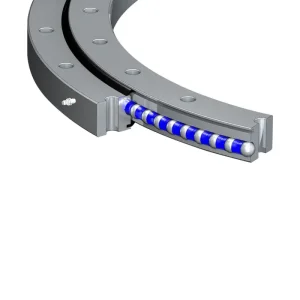
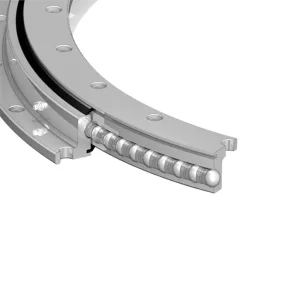
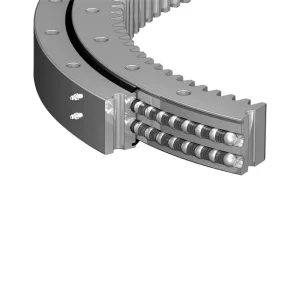
Heliostat fields are subjected to significant wind loads. The structural stability of the entire mirror field rests on the interface of the pedestal and the tracking gear mechanism. Here, single-row ball slewing bearings with internal/external teeth or gearless variants act as the main rotational linkage. The primary operational objectives include:
- High Overturning Moment Resistance: Buffeting winds exert high moment loads on the mirror facade. The slewing bearing must absorb these stresses without deformation, preventing structural failure of the tracking gear.
- Sub-Milliradian Pointing Accuracy: Concentrating sunlight onto a receiver kilometers away demands angular errors to be limited to less than 0.5 to 1.5 milliradians. Low backlash in gear mesh interfaces is crucial.
- Environmental Sealing: Desert storms, dust ingress, and humidity can degrade the internal ball-race. Special nitrile rubber sealing and custom grease pathways prevent friction spikes and premature wear.